Infant sleep • Materials • Safety
What to Look For in an Organic Infant Sleep Surface
Choosing an organic crib mattress can involve questions about fibers, finishes, certifications, and care. But the first priorities are more fundamental: a firm, flat surface; a snug fit in a compliant crib; and an empty sleep space. Organic materials may help explain how a product was made. They do not replace the safety requirements that matter most for an infant’s sleep.
Published November 26, 2026
A baby’s sleep surface is a small landscape with unusually high stakes. It must support the infant without yielding into a hollow, fit the crib without leaving hazardous gaps, and remain free of loose objects that could obstruct breathing. The cover and core may be made from cotton, wool, foam, or other materials, but the visible label is only one part of the picture.
For families drawn to organic bedding, the challenge is to weigh material information without allowing it to obscure the basics. A certification may tell you something meaningful about fibers or processing. It does not, on its own, establish that a mattress is appropriate for an infant, that it fits a particular crib, or that it meets the safety rules where you live.
This checklist offers a practical way to compare organic infant sleep surfaces. It is educational information, not a substitute for current guidance from your child’s health care provider or the safety authority in your country.
Begin with the sleep space, not the fiber label
For routine infant sleep, widely recognized safe-sleep guidance calls for placing a baby on their back on a firm, flat, non-inclined surface designed for infant sleep. Use a crib, bassinet, or other sleep product that meets applicable safety standards and follow its instructions. Keep the sleep area clear: the baby should have a fitted sheet over the mattress, with no pillows, quilts, blankets, stuffed toys, positioners, or other loose items.
These principles apply whether a mattress is conventional, organic, or made from a blend of materials. A soft topper cannot make a surface safer, and an appealing description such as “natural,” “breathable,” or “chemical-free” does not change the need for a firm, level surface. Avoid improvised sleep areas, including adult beds, sofas, and armchairs. If you are unsure whether a product is intended for infant sleep, do not infer its suitability from its materials or marketing language.
In the United States, check that the crib and mattress comply with the relevant Consumer Product Safety Commission requirements and consult the product’s instructions. Other countries have their own standards and approved product categories. Rules and recommendations can change, so verify current requirements where the product will be used.
1. Check firmness and shape
An infant mattress should feel firm and retain a flat surface under the baby. The mattress should not sag, form a depression, or allow the infant’s face to sink into it. A surface that feels comfortably plush to an adult is not necessarily appropriate for a baby. If you are comparing mattresses in person, assess them according to the manufacturer’s instructions and the applicable safety guidance, rather than judging by a brief touch alone.
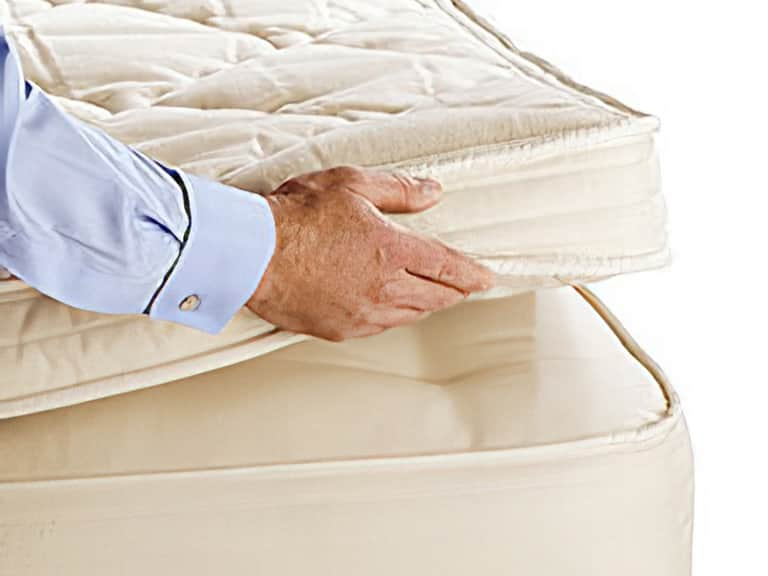
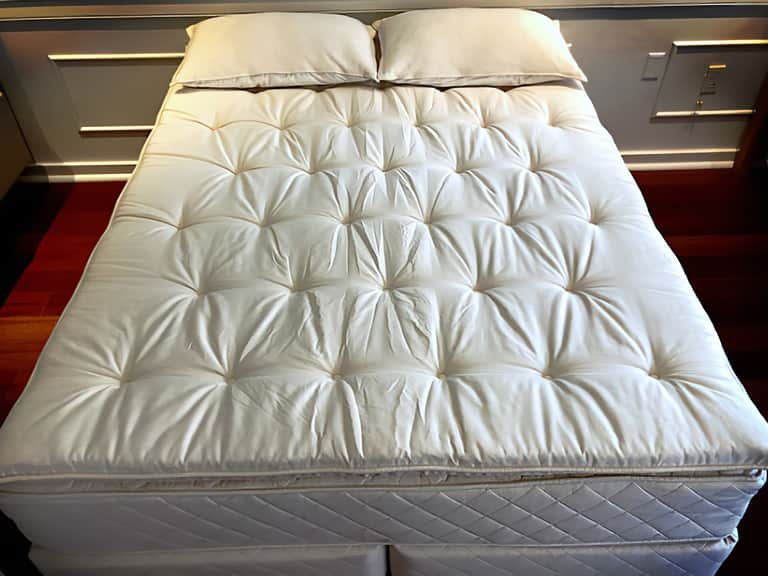
Look at the mattress from edge to edge. It should be even, with no raised pillowtop, deep quilting, or added cushioning that changes the surface. Do not add a separate topper to soften or “improve” the mattress. A topper, pad, or extra layer can alter how the sleep surface behaves and may introduce loose fabric or gaps. For everyday sleep, use only the mattress and a tightly fitted sheet that is made to fit it.
Words such as “supportive” and “comforting” are not measurements. Ask the manufacturer what infant-specific testing or standards apply, and look for documentation rather than relying on broad descriptive claims.
2. Confirm a snug fit with the exact crib
A mattress and crib work as a system. Even a mattress that meets relevant standards may not fit every crib, so check the crib manual for the mattress dimensions and type it permits. Confirm the product’s stated length, width, thickness, and intended crib compatibility before purchase. Then install it as directed and check that it lies level and does not shift or leave large gaps at the edges.
Do not rely on a label that says “standard size” as the only evidence of compatibility. Measure the crib’s interior as directed by its manufacturer and compare those figures with the mattress specifications. If the crib has an adjustable support, use the correct setting for the child’s age and development, following the manual. A mattress that is too small, too large, or incompatible with the support can compromise the sleep setup.
Inspect the fit again after assembly and whenever the mattress or crib is moved. If there is uncertainty, contact the crib or mattress manufacturer before using the setup. Never fill a gap with towels, blankets, foam, or other material.
3. Read the materials list as a construction map
“Organic mattress” can describe a product with several different layers, not a single material. A cover may be cotton while the core contains foam, latex, springs, or a combination of components. Some products also include batting, adhesives, barriers, stitching, or waterproof layers. A clear description should identify these parts rather than relying on one headline claim.
When comparing organic crib mattresses, look for a component-by-component account of the cover, filling, core, and any coatings or barriers. Note whether materials are described as organic, natural, recycled, or simply present. Those terms do not mean the same thing, and a product may contain materials with different origins and processing histories. If important details are missing, ask the manufacturer for written clarification.
Materials alone do not determine whether a mattress is safe for an infant. Nor can a general claim about breathability or temperature regulation guarantee a particular health outcome. Treat such language as a prompt for specific questions: What is the material? Where is it used? What test or standard supports the claim? Is the finished product intended and approved for infant sleep?
4. Understand what a certification does—and does not—cover
Certifications can make complex supply chains easier to understand, but their scope matters. For example, a textile certification may address the fibers or processing stages covered by its standard. It may apply to a fabric or component rather than every part of the finished mattress. A certification logo should therefore be accompanied by enough detail to identify what was certified and by whom.
GOTS, the Global Organic Textile Standard, is a widely used standard for organic textiles. Its relevance depends on the certified product or component and the standard’s scope; it is not a substitute for infant-product safety testing. A textile certification does not establish that a mattress fits a particular crib, is firm and flat, or complies with all required rules for infant sleep.
Ask whether the certification applies to the finished item, the cover, the fiber, or a specific manufacturing stage. Check the certifier’s information where possible, and distinguish independent certification from a company’s own description. Terms such as “eco,” “green,” “pure,” and “non-toxic” may be used in different ways. Without a defined standard or clear evidence, they should not be treated as proof of a safety characteristic.
Certification is one useful piece of a larger record: product identity, safety compliance, materials, construction, fit, and care instructions. No single seal answers all of those questions.
5. Look for clear safety and product documentation
A responsible product description should name the intended use and provide the information needed to identify the mattress. Look for a manufacturer, model name or number, dimensions, materials, use instructions, and warnings. Check whether the product is new and whether it has been subject to a recall. In the United States, consumers can search official CPSC recall information; elsewhere, consult the appropriate national product-safety authority.
Do not assume that a mattress is compliant because it is sold online, described as premium, or recommended in a review. Look for the manufacturer’s statement about applicable standards and, when needed, request details about testing and documentation. If a label is missing, instructions are unclear, or a seller cannot identify the product, choose a traceable alternative.
Be especially cautious with used mattresses. Their condition, history, and compatibility may be difficult to verify. A surface can appear intact while its structure has changed, and older products may not meet current requirements. Follow current local guidance and the crib manufacturer’s rules before considering a secondhand mattress.
6. Make care instructions part of the decision
Infant sleep surfaces need to remain clean, but cleaning methods vary by construction. Read the care instructions before purchase. Find out whether the cover is removable, whether the mattress itself may be wiped, and what products or methods are prohibited. Never soak a mattress or use a treatment that the manufacturer does not permit. Moisture trapped inside can create problems that are not visible from the outside.
Use a fitted sheet that matches the mattress dimensions and is designed to stay securely in place. If a spill occurs, follow the manufacturer’s directions and allow the surface to dry fully before use. Do not add an unapproved waterproof pad or extra cover beneath the baby. A product marketed as washable or protective still needs to be used in a way that preserves a firm, flat, well-fitted sleep surface.
Check the mattress periodically for damage, sagging, loose seams, exposed filling, or other changes. Stop using it if it no longer appears intact or does not fit securely, and seek guidance from the manufacturer. Keep product labels and manuals; they make it easier to confirm model details and follow care guidance later.
A practical comparison checklist
Before settling on an organic crib mattress, gather the product details in one place. A straightforward comparison is often more useful than a long list of adjectives:
- Intended use: Is the product explicitly designed for infant sleep and compatible with the crib?
- Safety compliance: Does the manufacturer identify the applicable standards and provide clear instructions?
- Firmness and surface: Is the sleep surface firm, flat, and free from added plush layers?
- Fit: Do the dimensions match the crib manual, and does the mattress sit level without hazardous gaps?
- Materials: Are the cover, filling, core, and additional layers described separately?
- Certification: Is the certifier named, and is it clear which components or processes the certification covers?
- Care: Are cleaning and drying instructions specific, practical, and consistent with the product construction?
- Traceability: Can you identify the manufacturer, model, instructions, and any recall information?
If the answers are vague, pause before buying. Ask the manufacturer direct questions and keep the replies with the product documentation. A transparent explanation is more useful than a promise that cannot be connected to a specific component, test, or standard.
The rest of the sleep environment matters, too
A well-chosen mattress is only one element of an infant sleep setup. Place the baby on their back for every sleep, on a clear, firm, flat surface intended for infant use. Keep soft objects and loose bedding out of the crib. Follow current advice about room-sharing and other safe-sleep practices from your local health authority, and discuss questions specific to your child with a health professional.
Dress the baby appropriately for the room and avoid overheating. If using a wearable blanket, choose one that fits correctly and is not weighted. Do not use weighted sleep products, inclined devices, positioners, or products that claim to prevent a baby from rolling unless current safety guidance specifically supports their use. Once an infant begins showing signs of rolling, follow current recommendations for sleep clothing and discontinue swaddling as advised by health authorities.
Caregivers may receive conflicting advice from advertisements, relatives, and social media. When guidance differs, prioritize current recommendations from recognized public health and product-safety organizations, along with the instructions for the crib and mattress. A clinician can help address individual concerns, including medical conditions that may affect sleep.
A calmer way to choose
Organic materials may matter to a family’s sourcing or environmental priorities, and certifications can help clarify some parts of a product’s story. The most useful choice, however, is not the one with the longest list of appealing claims. It is the one whose intended use, safety information, construction, dimensions, certification scope, and care instructions can all be understood and checked.
Start with a mattress designed for infant sleep that meets applicable standards and fits the crib exactly as directed. Keep its surface firm and flat, use only a fitted sheet, and leave the sleep space clear. Then compare material and certification details as additional information—not as substitutes for those essentials. In a room arranged for a baby, safety is less a matter of adding special layers than of choosing the right surface and keeping it simple.
Key takeaways
- A safe infant sleep surface should be firm, flat, and intended for infant sleep.
- Confirm the mattress fits the exact crib and follow both products’ instructions.
- Organic materials and textile certifications describe particular materials or processes; they do not replace safety standards.
- For routine sleep, use a fitted sheet and keep the sleep space free of toppers, loose bedding, toys, and positioners.
- Check product documentation, care instructions, and recall information, and seek current local guidance when uncertain.